The Cosmic Order Manifested

Engineered Divinity

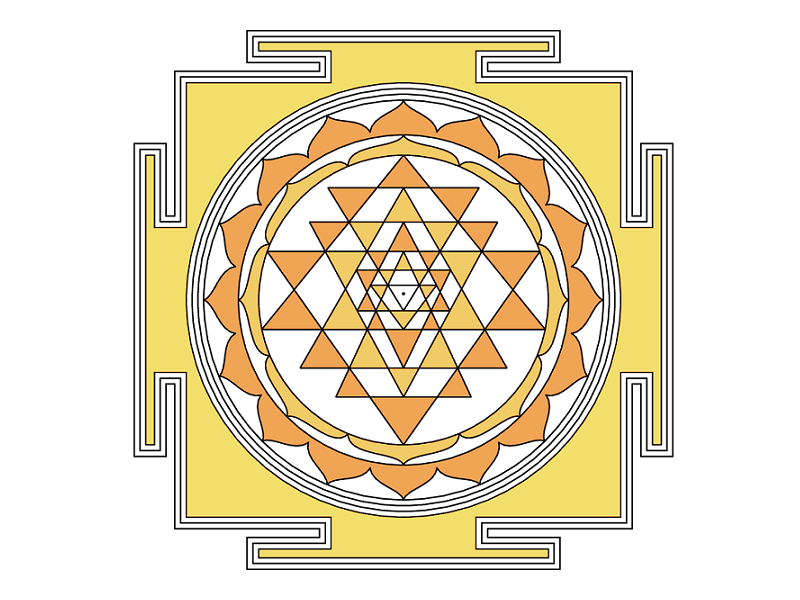
The Shree Yantra, also called the Sri Chakra, is one of the most revered sacred geometries in Hindu tradition. It consists of nine interlocking triangles radiating from a central bindu, forming forty-three smaller triangles arranged in concentric levels.

In Vedic and post-Vedic thought, it is understood not merely as a diagram but as a map of cosmic order, divine consciousness, and the relationship between the manifest and unmanifest worlds. It is especially central to Shri Vidya worship, where the yantra is treated as the geometric form of the Divine Mother.

For a modern scientific correlation, the strongest and safest framing is not to claim proven physical effects, but to note structural parallels: symmetry, proportion, recursion, center-periphery organization, and the cognitive impact of focused geometric meditation. The yantra can be studied as a psychogeometric symbol that organizes attention, supports contemplative practice, and encodes layered meaning through form.
Explore the Science View Catalogue
Classical Shree Yantra

In temple architecture, the Shree Yantra is reflected in the planning of sanctums, mandala-based layouts, and meru-style superstructures. A temple is often conceived as a three-dimensional expression of the Sri Chakra, with the sanctum sanctorum corresponding to the bindu.

Notable examples include the Kamakshi temple tradition at Kanchipuram, the Sri Yantra Meru Nilayam at Devipuram (an inhabitable 3D Sri Yantra), and the Shree Yantra Temple at Amarkantak.

Types of Shree Yantra Construction

While the geometry remains constant in essence, Shree Yantras may be constructed in distinct formats—each suited to worship, preservation, or display. Construction styles are commonly defined by color palette, metal choice, surface finish, and whether the yantra is offered with a supporting frame.

1. By Finish Style (Surface Treatment)

  • Natural (Bare) Metal Finish: Ideal for devotees who prefer a raw, unaltered look. Retains the character of the base material and gives an organic, artisanal form.
  • Electro-Plated Finish: Designed for a crisp, refined appearance with enhanced uniformity. Strengthens visual clarity and helps engraved lines read sharply.
  • Powder Coated Finish: Selected for durability and a modern aesthetic. Supports long-term preservation, well-suited for regular puja use and display environments.

2. By Material (Metal Selection)

  • Copper: Widely valued for its traditional association with warmth, devotion, and living material character. Often selected for worship-centric yantras.
  • Steel: Offers sturdiness and reliable structural form. Suits yantras intended for frequent handling, long-term storage, or modern artifact presentation.
  • Aluminium: Lightweight yet stable, making it practical for portable worship setups, larger formats, and installations where manageable weight is important.

3. By Structure & Purpose

  • With Frame: Provides a defined boundary, elevating the yantra into a complete devotional object. Protects edges and makes the piece suitable for altar placement or gifting.
  • Without Frame: Appears in its most direct form—minimal and intimate. Often preferred when the yantra sits within a larger ritual arrangement.
  • For Worship (Puja): Materials are selected for clarity, comfort of use, and long-lasting detailing (e.g., electro-plated).
  • For Artifact / Display: Durability and presentation become central (e.g., powder coated surfaces, optional framing).

4. By Color Composition

Color carries symbolic weight in shrine culture and influences the legibility of micro-forms:

  • Gold: Luminous sanctity and ceremonial emphasis
  • Silver: Clarity, calm, and refined brightness
  • Copper: Warmth, tradition, and grounded devotional tone
  • Black: Depth, mystery, and strong contrast for etched geometry
  • White: Purity, simplicity, and visual stillness
  • Red: Power, intensity, and energetic presence

The Essence of Our Offerings

Elevate Your Spiritual Practice with Our Premium Yantras. Discover what our specialized terminology signifies in the context of luxury and authenticity.

1. Engineered Precision

In the world of Yantras, "close enough" is spiritually ineffective. We use modern CNC machines to ensure the geometry is perfect. If the lines of the 9 interlocking triangles don't intersect at the exact mathematical point (Bindu), the "circuit" is broken.

2. Vedic Diagrams

The design isn't just "pretty art"; it is pulled directly from ancient texts like the Saunderarya Lahari or the Tantraraja Tantra. A "Vedic Diagram" guarantee means we have verified lotus petals, gates, and angles against classical manuscripts.

3. Material Sanctity

In Vedic thought, metals act as conductors for energy. Our metal is unadulterated—using 925 Sterling or 999 Fine Silver, and high-grade electrolytic copper. Material sanctity ensures the "vessel" is pure enough to hold the divine energy.

4. Quality Crafted

Unlike cheap, stamped tin plates that tarnish or bend, our Yantras are heavy-gauge and finished with requisite polishing methods. Quality crafting ensures the etchings don't rub off and the metal doesn't corrode over years of ritual use.

5. Comprehensive Support

A Yantra is a "tool." If you don't know how to use it, it’s just a paperweight. We provide a "manual" for its use, including:

  • Installation Guidance: Helping you place it in the correct direction (usually North-East).
  • Mantra Instruction: Providing the correct mantra to "activate" the Yantra.

Vedic Science & The "Queen of Yantras"

The Shree Yantra represents the cosmic evolution of the universe and the union of the Divine Masculine and Feminine. It is a profoundly technical "machine" (Yantra means "instrument") detailed in Tantric Shastras and the Vedas.

1. The "Hardest" Geometric Puzzle

Drawing a perfectly symmetrical Shree Yantra where all intersections (marmas) meet exactly at a single point is a feat of advanced spherical geometry. Changing the angle of one triangle affects all others.

Vedic Reference: The Nityashodashikarnava defines the "Chakras" (nine levels), describing the 4 upward (Shiva) and 5 downward (Shakti) triangles as the "intermingling of divine rays."

2. Frequency and Sound (Cymatics)

In Cymatics, researchers found that chanting "Om" into a tonoscope naturally forms shapes resembling the central triangles of the Shree Yantra.

Vedic Reference: The Shree Suktam and Lalita Sahasranama detail the ritualistic Seed Mantras, describing the Goddess as "Yantra-Raja-Lila-Vibhavini" (She who enjoys the play of the King of Yantras).

3. Neurological Impact

Studying the effect of "Trataka" (fixed gazing) reveals that its fractal-like geometry, which follows the Golden Ratio, induces a "Flow State" (Alpha brainwaves) and balances the left and right hemispheres of the brain.

Vedic Reference: The Spanda Karika discusses the universe as vibrations, and Saundarya Lahari suggests meditating on these proportions aligns internal energy with the cosmos.

4. Fractal Nature & The Holographic Universe

The Shree Yantra is a self-similar structure. The more you zoom in, the more patterns repeat, mirroring the holographic theory of the universe.

Vedic Reference: The Bhavana Upanishad maps the Shree Yantra onto the human body (the nine circuits correspond to the nine gates/chakras), asserting "What is here is there, and what is not here is nowhere."

Scientific Perspective & Anatomical Mapping

Measuring the impact of the Shree Yantra scientifically involves moving from subjective spiritual experience to objective data across the brain, bio-field, and environment.

Measuring the Impact

  • Brain Activity (EEG): Meditating on the Yantra triggers Alpha Rhythm Synchronization and deactivates visual noise, entering a "pre-hypnotic" focused state.
  • Energy Field (GDV / Bio-Well): Based on the Kirlian effect, studies show it can expand the aura size and shift chakras toward a balanced vertical line.
  • Environmental (Lecher Antenna): Precise 3D Shree Yantras are said to create a "toroidal" energy flow that harmonizes geopathic stress, mimicking pyramidal power.
  • Visualizing Vibration (CymaScope): Provides physical proof that the frequency of "OM" creates Yantra-like geometry in water or sand.

Mapping: Yantra to Human Anatomy

The Bhavana Upanishad provides a systematic mapping (Nyasa) of the Yantra's geometry onto biological functions:

  • Outer Square: Physical frame & ten sensory organs.
  • 16-Petal Lotus: Desires and biological urges.
  • 8-Petal Lotus: Internal states (speech, movement).
  • 14-Triangle Ring: 14 Nadis circulating Prana.
  • Outer 10-Triangles: Ten vital breaths (Pranas).
  • Inner 10-Triangles: Digestive fire & metabolism.
  • 8-Triangle Ring: Subtle toxins (anger, greed).
  • Central Triangle: The Gunas and core creative energy.
  • The Bindu: Pure Consciousness (The Atman).
The "Placebo" & Material Effect: Scientifically, yantras don't alter physical room parameters like CO2. However, a large copper yantra can act as a localized EMF shield (Faraday effect). More importantly, the psychological "Observer Effect" anchors behavior—fostering mindfulness, lowering cortisol, and raising Alpha wave activity (Neuro-esthetics).

Meditation using Shree Yantra (Trataka)

To practice visualization meditation, we use Trataka (steady gazing) followed by Antar Mouna (inner silence). By "tuning" the Yantra through meditation, you are essentially performing a software update on your own biological hardware.

  1. Phase 1: Preparation. Place the Yantra at eye level, sit in Sukhasana, in a dimly lit room.
  2. Phase 2: Physical Gaze. Keep eyes open. Trace the outer square, move to the petals, follow the interlocking lines, and finally fix fiercely on the central Bindu until the rest blurs.
  3. Phase 3: Internal Visualization. Close your eyes. Pull the glowing "after-image" to your Third Eye. Visualize the Bindu expanding into the whole Yantra while mentally chanting "Shreem."
  4. Phase 4: Dissolution. Imagine the Yantra shrinking back down into the Bindu, merging into your consciousness. Sit in silence.

Sacred Geometry Across Religions

Many religions have unique symbols that perform similar functions as focal points for meditation, balance, and representation of divine principles.

  • Buddhism (Mandalas): Circular designs representing the universe, symbolizing wholeness to focus the mind.
  • Christianity (Cross & Icons): The cross represents salvation, while icons serve as focal points for prayer and connection with the divine.
  • Islam (Geometric Patterns): Intricate geometry and calligraphy guide meditation, representing the infinite nature of Allah.
  • Judaism (Star of David): Serves as a focal point in rituals and a symbol of identity.
  • Taoism (Yin-Yang): Expresses the dual nature of reality and serves as a point of focus for balance and harmony.

The Scientific "Energy" Audit

In building science, a "high-energy" workspace is measured through environmental factors that affect human biology, focus, and comfort. The Vedic perspective aligns with this by advocating for Vastu principles—orientation, materials, and elemental harmony.

Environmental Factor The Science / Problem Healthy Level (High Energy) The Fix
Air Quality & Chemistry High CO2 (>1000 ppm) lowers decision-making by up to 50%. VOCs cause fatigue. CO2 < 800 ppm
Humidity 40-60%
Cross-breeze ventilation, HEPA/Carbon purifiers, and biophilic plants (Snake Plant).
Electromagnetic (EMF) Interferes with sleep cycles and causes physical stress (jittery energy). Magnetic Field < 1.0 mG Distance from routers, grounding equipment, and using shielded power strips.
Circadian Lighting Dim light (under 300 Lux) causes eye strain. Wrong color temp disrupts melatonin. 500 - 750 Lux (Desk)
5000K Day / 2700K Night
Indirect bounce lighting, smart bulbs for circadian tuning, avoiding harsh glare.
Acoustic Energy Constant background hums (AC/Traffic) increase cortisol and drain mental energy. Background < 45 dB Soundproofing, white noise, or intentional chanting/mantra integration.

The "Yantra" Strategy in your Environment: Place the Yantra where your eyes naturally rest during a break. By associating that specific geometry with "deep work" or "calm", you use classical conditioning to train your brain to enter a specific state when observing it. Their effectiveness lies in focused intention, making them invaluable tools for psychological recalibration.